School Committee takes important step to move elementary school building project forward

Sibling enrollment and restoring specials teachers to be discussed at next meeting

On Tuesday March 8, the Amherst School Committee voted unanimously to approve the educational program and space summary for the elementary school building project. This vote was an important step in moving the project forward, on a path to completing the project and opening the new school in the fall of 2026.

The committee first viewed a short presentation on the educational program, a 34-page document that summarizes how elementary education is delivered in our district. I had already sent the superintendent and the lead designer my input on the educational program, and I summarized my input at the meeting:

  • Wildwood and Fort River each have around 350 students right now, for a total of around 700 students. The enrollment in the new building will be 575; in other words, the new school will have about three-quarters the number of students as WW and FR today. And yet, based on the Educational Program, it seems that there are many cases where staffing in the new school is at the same level as in the two schools combined. 
  • For example, according to the Educational Program, there is currently one psychologist each in WW and FR, and two will be required at the new school. But with a reduction in students from 700 in the two schools combined to 575 in the new school, I would expect to need fewer than two FTE psychologists. I don’t say this to imply that we shouldn’t provide the services that our students need, but just from the math, I would expect that fewer students would require comparably fewer staff. The same holds true for adjustment counselors and guidance counselors. According to the educational program, there is currently one each of these two positions at Fort River and Wildwood, and two each are stated as a requirement for the new school. Again, the same number of staff for fewer students. The more staff we have, the more space needed to house them. This is one of the reasons that the total size of the building is bigger than it needs to be, in my opinion.
  • In addition, the Literacy Professional Center sounds like a nice to have, not a need to have. There appears to be multiple other spaces in the building to serve as alternate locations for specialized small group or one-on-one instruction, as well as staff collaboration. If we had unlimited funds, we could fulfill all of the “nice to haves,” but when difficult decisions need to be made to keep the building both within our means as a community and right-sized for the environment, then we need to be willing to forgo some of the nice to haves so that we can focus on the need to haves.
  • Lastly, I feel that the descriptions of access to the outdoors and outdoor space needs are insufficient in the educational program. Our students deserve and need ample, accessible, and age-appropriate play scapes, space for creative play on fields and hardtops, and continued access to the outdoor learning that has been so important in these last two years of the pandemic.

Other committee members also voiced their opinions on the educational program.

Next we viewed a short presentation on the space summary, a detailed spreadsheet that describes the number and size of rooms and spaces needed in the new school, as well as the total square feet of the building. The latest proposal describes a total building size of 105,750 square feet.

(Both the educational program document and the detailed spreadsheet can be viewed in the School Building Project Education Plan agenda item of the March 8 meeting on Boarddocs, in the attachment called 22-03-02 Ed Plan_DRAFT.pdf)

Many of the comments, from School Committee members as well as from members of the public via email, voicemail, and live comments at the meeting, centered around the size (square feet) of the building. Some think we needed to make the building bigger – bigger and more rooms to serve our students. Some felt we needed to make the building smaller – use space more efficiently, lower cost, more environmentally sustainable.

Here are the remarks I made about the building size:

I’m looking at the project from several perspectives and points of view, and one point of view is that I’m a single parent who works full time and owns a house I can’t afford. I am perpetually in arrears on my property taxes. It’s the first bill I put off paying, or don’t pay in full, when my finances are tight, which is most of the time. That said, as a voter, I fully intend to vote in favor of the debt exclusion override next year, to pay for this school building. The increase in my property tax bill won’t force me to move out of town, but it will impact my quality of life – it will reduce my ability to pay my bills on time, and to pay for extra things like extra-curricular activities and hobbies for myself and my child. But as a tax payer and as a voter, I’m all in.

As an elected official, my job is to make sure that residents like me, who struggle to make ends meet, whether they are homeowners or renters, are not faced with a higher tax burden than is absolutely necessary, for a school project to meet the educational needs of our students. In addition there will be those who will be pushed out of town due to higher rents and higher property taxes. Already, living in Amherst is out of reach for many families. If we make it even harder to live here, then who is this school for? Is it only for people who can afford the higher tax bill or the higher rent that results from the higher tax bill? We say that our mission is the academic achievement of every student learning in a system dedicated to social justice and multiculturalism. But there is no social justice or equity in a town that only resourced families can afford to live in. 

We know that the size of the building is just one element of the cost. All of the other elements that go into the cost of the project are out of our control, but this one thing is within our control. At each step in this process, each individual or group that makes decisions, whether it’s the school committee, the school building committee, or the town council, has to do their part to develop a reasonably sized and priced building that meets the educational needs of our students, AND that our community can support, AND that is a net-zero building. While each body has a different piece of the total picture, we can’t make decisions in a vacuum; we must consider the whole picture. Tonight it is this body’s moment to do our part. We need to hand off to the school building committee an educational program that meets the needs of our students, and a space summary and total square footage that sets them up for success in terms of completing this project at a cost this community can bear. And then it will be the responsibility of the town council and the voters to approve the tax increase and the borrowing. But we get to go first, tonight, and we need to set ourselves up, to set this project up, for success. 

A right-sized building is the right choice for fiscal reasons, as well as for environmental reasons. This will be the first major town project to be built under our excellent net-zero bylaw. And there is already talk in the Town Council about weakening the net-zero bylaw to control the cost of this project. We don’t want that to be this project’s legacy. We don’t want to look back and say, we had a great net zero bylaw but we revised it so we could afford the school project. We owe it to our students, both our current students and the ones who will be inhabiting this building for 50 years to come, to deliver a right-sized, net-zero building.

All that being said, I’m not planning on suggesting any reductions to the current proposed plan. I also could not support any increases to it.

In the end, no proposals were made to increase or decrease the building size, and all School Committee members voted in favor of it.

Next we discussed the FY23 budget. I requested of Doug Slaughter, ARPS director of finance, to show us a version of the budget that restores the cuts that were made to specials teachers last year, which were implemented in this current academic year. The plan was to reduce the Art and Technology specials teachers at Crocker Farm to part-time, and have the teachers in those positions from Wildwood and Fort River fill in the gaps at Crocker Farm. I don’t know how this plan actually played out, but I hope to hear about it at our next meeting. Superintendent Mike Morris responded that a budget that includes restorations to those specials positions would simply pull the funds from ESSER funds (a federal relief program) and would not be permanent. It was agreed that this would be on the agenda for our next meeting.

I also asked about the policy for siblings of students in district-wide special education programs to be able to attend the same school. Currently, if a student is enrolled in a special education program that is not located in the school they are districted to, that student can attend the other school, however this sometimes results in siblings attending different schools. This topic was supposed to be discussed by the School Committee in fall 2021, in preparation for the FY23 budget, but it wasn’t discussed. It was also agreed that this would be on the agenda for our next meeting.

As of now, our next meeting will be Tuesday, March 29, at 6:30. It hasn’t been officially scheduled yet, so keep an eye on the Amherst School Committee page on Boarddocs for confirmation. You can also sign up on the town of Amherst’s website to be notified when a new meeting is posted (scroll down to Calendar >> Boards/Committees), BUT you will be notified of every town board or committee meeting AND this does not apply to Amherst Regional School Committee meetings.
Where are we with the elementary school building project? (2/22/22 Amherst School Committee meeting)

I’ve mentioned in a previous post that the MSBA (Massachusetts School Building Authority) is like the bank in our elementary school building project. They will partially fund the project, and as the funder they require information and documentation about our project, as part of their process of working with school districts. The next step in the process for us is to submit the “Preliminary Design Program” (PDP) to the MSBA. Two important elements of the PDP are the educational plan and the space summary. 

The educational plan is a document that describes how we deliver elementary education in Amherst, and what building elements are necessary to fulfill our needs. This document is 35 pages, and can be found on the BoardDocs page for the February 22 meeting (it is called 22-02-17 Ed Plan_DRAFT.pdf). The educational plan feeds the space summary, which is a giant spreadsheet that can be downloaded from the same page (22-02-17 FRES reduced program areas options (1).xls).

The February 22 meeting was largely devoted to going through the space summary section by section, with School Committee members asking questions and offering suggestions to the superintendent and the lead architect. Other members of the administration also attended the meeting to answer questions. We talked about things like the size of classrooms, the size and number of “project areas” rooms, the size and number of staff offices, the size of specialty rooms such as occupational/physical therapy rooms, the size of the gym, the size of the cafeteria, etc. It was all very detail-oriented, and rather tedious, but super important!

At the beginning of the meeting we heard and read public comments about the project. Here are the things I took away from the various comments we received, and the things I kept in mind when considering all the details about space in the building project:

  • In order for this project to move forward to completion, Amherst voters will have to vote in favor of raising our property taxes for 30 years, via a debt-exclusion override*, to pay for the town’s portion of the building. Living in Amherst is already out of reach for many people, and current residents are finding it harder to afford living here. When we ask people to vote on raising their taxes, we need to be able to tell them that the amount that we’re spending on the building is not more than what we need in order to be able to deliver quality education to our students. As one commenter wrote, “We must ensure now, before we are locked in, that the size of the building is no bigger than absolutely necessary and uses all space extremely wisely.”
  • This will be the first major town project to be completed under the net-zero bylaw. All other things being equal, a net-zero project costs more than a non-net-zero project. Our community has decided that fighting climate change via net-zero buildings is something that we value, therefore we must be willing to balance other needs in order to achieve net-zero. As another commenter wrote, “We don’t want to jeopardize the new school and our first net zero project by sticker shock due to an unnecessarily large new school building.  There would also be a temptation for some to blame the net zero bylaw for the sticker price, which could undermine public support for the bylaw, one of the town’s essential efforts to fight climate change.”

I’m not an educator, nor an architect. I don’t have any expertise when it comes to how many square feet a break-out room or counselor’s office should be. I see my responsibility as representing the public and the school community, to deliver a project that people can support. I almost wrote “deliver a project that everyone can support” in that previous sentence, but I don’t believe in platitudes, and I don’t expect the debt-exclusion override to pass with 100% in favor. In fact, it only needs 50% + 1 voters in order to pass. But, I would love to see it pass with 60%, 65%, 70% in favor!

My overall feedback to Mike (superintendent) and Donna Dinisco (lead architect) on the space summary was: It would be great if we could get the building size down from the current/latest proposal of 105,750 square feet to around 100,000. AND we should focus on prioritizing space for students, and where reductions need to be made we should look to reduce individual/dedicated space for adults.

I’m hopeful that Dinisco and team will be able to take in the feedback from the other School Committee members and me, and come back on March 8 with a right-sized building. We will also be presented with cost estimates for the first time at that meeting. And we will need to vote our approval on the educational plan and space summary at that March 8 meeting. 

Stay tuned! This is a very exciting time for this building project!

*Here is a useful article that explains what a debt-exclusion override is: https://patch.com/massachusetts/norton/explaining-what-a-debt-exclusion-really-is

Amherst’s school building project: We need to set ourselves up for success

At the February 8 Amherst School Committee meeting, the SC discussed a high-level summary of how space would be allocated in the new elementary school building. The summary was displayed in the form of a table on page 11 of the presentation given to the SC by Donna Dinisco, lead architect on the project. (To access the presentation, go to the February 8 meeting page, click on the agenda item “Building Project Update – Education Plan Presentation” then click on the attachment called “21555 22-02-08 School Committee (final).pdf)

First, a primer on how to read the table on p. 11, titled “Preliminary Design Program | Enrollment Alternatives.” The first two columns represent a building option that we are required to study (renovating or replacing Fort River only), and did not warrant any discussion by the SC. The second two columns are where we focused much of our time.

The column titled “Fort River + Wildwood Schools @ MSBA” had part of its title cut off due to formatting, and was actually called “Fort River + Wildwood Schools @ MSBA Standards (575 students)” in a previous version of this document. This column represents a high-level summary of the proposed space usage in the new school. The “MSBA Guidelines (575 Students)” column indicates the amount of space that the MSBA recommends based on their guidelines. (NFA stands for Net Floor Area; GSF stands for Gross Square Feet. You can think of both as “square feet of space.”)

The first eight rows are categories of space needed in the school. The Sub Total Program row is a sum of the eight rows above it. After you add up the proposed space for each category, you must then multiply by a “grossing factor” to account for hallways, bathrooms, stairs, and even just walls. (The MSBA uses a 1.43 grossing factor, but for this project our architects have used 1.5).

So, the total square feet for our proposed project is 113,765, which is around 29,000 more than what the MSBA would recommend for our project (85,052).

Phew! Are you with me so far?

So, for me, the important thing is not how big the school project is but how much will it cost Amherst taxpayers, and the size of the building is one of the main factors that determines the cost. The town manager and the town finance director gave a presentation to the Town Council in February 2021 on how the town would be able to afford four major building projects (elementary school, Jones Library, department of public works, and fire station). The model indicated an estimate of $80 million for the school building project, with the town’s share of that at $40 million (and the assumption being that the MSBA would fund $40 million ).

I asked Donna if she could give a rough, ballpark estimate of the cost of our building project, or even a rough cost per square foot. She said they weren’t ready to give a cost estimate or range at the time, and that she expected to be able to do that at the March 8 SC meeting, the meeting at which the SC is expected to vote to approve the educational program.

That said, using the figures that we do have, I did a rough back-of-the envelope calculation.

If we need the project to come in at $80 million (assuming MSBA will reimburse us for $40 million and the Amherst taxpayers will pay $40 million):

$80 million divided by 1.25 = $64 million. This 1.25 factor represents the “soft costs” that are not direct construction costs (“hard costs”), such as architect and OPM fees, site costs, etc. We don’t know what the soft cost amount will be, but a 1.25 factor (or 25% of construction costs) is a reasonable guess.

$64 million divided by 113,765 sq ft = $563 per sq ft

Is it reasonable to think that our building can be built for $563 per sq ft? Good question! I am not a construction expert, so I don’t claim to know the answer. Looking at data on recent MSBA projects tells me that there is a range from around $430 to $825 per sq ft. Given that our school building will be net-zero, per Amherst bylaws, do we think our building will end up being low, middle, or high of that range? These are all questions that need to be answered before the School Committee votes on March 8. 

The cost of this project is important, because Amherst voters will be asked to approve a debt-exclusion override for it, a vote that is likely to take place in March 2023. Approving a debt-exclusion override means that voters are agreeing to “override” the state’s limit of 2.5% on how much towns can increase property taxes. In other words, the town can’t raise property taxes more than a 2.5% increase, to pay for this project, unless voters agree to it. (And the February 2021 presentation I referenced above stated that raising taxes via the debt-exclusion override is the only way the school project can be funded.)

The last time Amherst voters were faced with a debt-exclusion override vote, in 2016 for the previous school building project, it passed by 126 votes, out of 13,524 total votes cast (6,825 yes; 6,699 no). That is a little too close for comfort for me (50.4% yes; 49.5% no), and shows how divided voters were at the time. I would love to see this building project pass its override vote with 60%, 70%, 75% voter approval! The public should be excited about a public school, not only because they will have to pay for it via property taxes, but because a public school reflects the community’s values.

If we want the public to be enthusiastic about this project, we need to set ourselves up for success by developing a project that people can be excited, or at the very least accepting, to have their property taxes raised for. We need this project to cost an amount in the range of what our finance experts have planned for, so that voters can get behind it, and so that the town’s other major capital projects can move forward.

“Most of the principals who have left the district have been women” (Amherst and Regional School Committee meeting: 2/1/22)

This meeting started out as a joint meeting of the Amherst School Committee, Amherst Regional School Committee, and Pelham School Committee. (For a refresher on the difference between the Amherst School Committee and the Amherst Regional School Committee, see my Amherst has two school committees? post.)

These three school districts share a superintendent (currently Mike Morris) and the first item on the agenda was to review the process for evaluating the performance of the superintendent, which is done annually. 

The next item on the agenda was a presentation from consultant Rick Rogers on a qualitative study he conducted on why our district has had high principal turnover in some schools. The report that Rick produced is straightforward and easy to read, and contains some really meaningful and important points. (I recommend anyone interested in supporting Amherst schools read the report: Supporting and Retaining School Leaders.) Here are some of the nuggets I took away from his presentation and report:

  • It’s not easy to be a school principal in Amherst, “where only the H is silent.” In a community that prides itself on being highly educated, people often question the decisions of those in positions of power. In my opinion, this is not, in and of itself, a bad thing. But when the feedback and questioning turns personal, that is where the problems lie. Respondents in Rick’s study (current and past principals, and district administrators) reported experiencing personal attacks and name-calling.
  • A direct quote from the report: “It is worth noting that the longest serving administrators (Superintendent and three principals) are all white men. It is also noteworthy that most of the principals who have left the district have been women.” In my opinion, this is one of the most important findings to come out of this study. Although this is just one snapshot in time, and the “sample size” is small, it seems that Amherst has a much harder time holding onto women as principals than men. Another direct quote, which I found very distressing: “Some women leaders reported feeling that their gender contributed to a lack of respect and they were more likely to be the subject of comments about their age, appearance or eating habits.” Eating habits! Women principals reported that people feel the need to comment on their eating habits! To me, this is a sign that even Amherst is not immune from patriarchal attitudes towards women.
  • Another interesting nugget is this: “… veteran principals cited “coming up through the ranks” as contributing to their longevity.” If Amherst is a tough town to be a principal in, perhaps educators who have been in the district for a number of years would have more “staying power” than someone from the outside. When I asked Rick about this, he responded that he was aware the district has some initiatives to support educators in working towards principal licensure, but that this is not a comprehensive solution, since a district will always need principals from outside the district, and that in fact it is good to have some leaders who come from outside the district. I can see his point, but I maintain that supporting current Amherst educators to work towards a principal position should be one prong of the district’s approach to supporting successful principals.
  • I asked Rick why his recommendations did not include something specific to supporting women principals. The recommendations he gave seem excellent, and seem that they would support people of all genders, but since we know that women principals are more likely to leave, I felt that we needed some action items to support women in leadership positions. He acknowledged that he wished he had included something on this topic.

After this discussion was completed, the Pelham School Committee and the Amherst School Committee were adjourned. But of course, two of the Pelham members and all five of the Amherst members are also members of the Regional School Committee, so we stayed in the meeting. Some highlights from the rest of the meeting:

  • In Mike’s Superintendent’s Update he shared that he has received some communications from families asking whether and when the district will lift or ease the masking mandate. He said that at this time the Town of Amherst’s indoor mask mandate is still in place, and as long as that is the case, the school district can’t lift our mask mandate (“it’s a moot point for schools right now”). In addition, he spoke with the town’s health director who said “not yet”; it’s not time to lift the mask mandate yet. Also, the CDC still says that universal masking in schools is the best protection.
  • We had a presentation from Doreen Reid, ARMS assistant principal, and Sarah Fefer, UMass professor of school psychology, on the Happiness Project. This initiative is taking place in ARMS, where students were screened on overall well-being, and those whose screening indicated “room for growth in happiness” were eligible to participate. Around 20 students participated in small group sessions with a trained facilitator once a week for 10 weeks, with the goal of increased life satisfaction, strengthening relationships, and promoting gratitude and positive feelings. The program will be repeated next year with a different cohort of students. 
  • A “School Choice Hearing” was next on the agenda, which was intended to be a public hearing (an opportunity for the public to weigh in) on school choice (allowing students who reside outside of Amherst, Pelham, Leverett, or Shutesbury to attend ARMS or ARHS). No members of the public made comments. The committee had some discussion about the logistics of school choice, a little bit about the pros and cons, and our past history as a school choice district (or not). Students who “choiced in” at any of the four towns’ elementary schools prior to the 2019-20 academic year will be able to stay in the district and attend ARMS and ARHS. However, a new state regulation means that students who choice in for elementary school in the 2019-20 school year or later will not automatically be enrolled in middle and high school in that district. At a future meeting, the Regional SC will vote on whether to allow new students to choice in to ARMS and ARHS. (Note: a previous version of this blog post mis-stated that all current K-6 school choice students would be able to stay in the district for middle and high school.)
  • We discussed a potential new policy to require students in extracurricular activities or sports to participate in pooled testing. Pooled testing (the process of testing a group of students as a “pool,” then following up with individual tests if the pool is positive, is more efficient than individual testing) is optional for students and vaccinated staff. The question was, should we require students to participate in pooled testing, as a prerequisite for extracurricular activities or sports. I asked what the goal of this policy would be? Presumably, the goal is to minimize the spread of COVID in schools, but is COVID more likely to spread in extracurricular activities or sports? Are those settings more risky than, say, eating lunch unmasked? Would this policy actually help mitigate the spread of COVID? We heard from the superintendent that this prospective policy isn’t a priority right now. Ultimately, after some discussion, the committee decided not to pursue it at this time.
  • We reviewed a prospective new policy that would require the district to “​​provide a written translation of vital documents (as defined in District guidelines) for each language that constitutes at least 5% of the District’s total multilingual student population.” We were told that, at this time, the two languages that constitute at least 5% are Spanish and Portuguese. I think this is a great idea! And/but I would like to see this investigated further. I was surprised that Chinese was not on the “5% or greater” list. I also believe that if we are going to institute a policy to help multilingual families, we should talk to multilingual families about what their translation and interpretation needs are. “Nothing about us without us,” to borrow a phrase from disability activists.
  • School Committee member Irv Rhodes appeared to have some connectivity issues. He joined by phone for the earlier part of the meeting, but he dropped and re-joined several times. 

January 18: Amherst School Committee and Regional School Committee meetings

Amherst School Committee Meeting: 1/18/22

This extra meeting of the Amherst (elementary) School Committee meeting was called in order to get an update on the elementary school building project. Margaret Wood, a consultant with Anser Advisory, is the owner’s project manager (OPM) on the project. The job of the OPM is to provict project-management guidance to the building committee and the town through the life of the project, manage communication and outreach with the community, and handle interactions with the Massachusetts School Building Authority (MSBA). Margaret started the meeting by telling us that the MSBA is like “the bank” in this project. Since they are providing funding, they require documentation of our process and progress.

The next submission of documentation to the MSBA will occur in early March, and will include the preliminary design program (PDP). The PDP comprises the educational program, which is basically a description of how elementary education is delivered in Amherst and needs to be approved by the School Committee, plus a list of options for the project (# of students enrolled and in what grades, Wildwood vs Fort River site, renovation vs new construction).

I asked about the outreach plan to get input on the educational program, and the timing for viewing, voting on, and approving the ed program. The School Committee will view the educational program at our February 8 meeting, and the plan is to vote on it at our February 22 meeting.

Regional School Committee Meeting: 1/18/22

The public comments submitted for tonight’s Regional School Committee meeting were all regarding, and all in favor of, the project to renovate and improve the ARHS track and field. It struck me that someone involved in athletics must have sent an email blast to their contacts, asking them to submit comments for tonight’s meeting, which is great! It’s great to know that members of the public are paying attention to school committee agendas, know how to submit public comments, and encourage their peers to do so as well.

Observations from the meeting:

  • According to Superintendent Mike Morris, the ARHS track, and the field within it, is in very poor shape and has been for years. The condition and size of the field disqualifies it for some tournament games, which means that ARHS sometimes can’t host their own home game, and have to play on a neighboring district’s field. 
  • In addition, the orientation of the field and the surrounding landscape make it inaccessible for those wheelchair users and others with movement issues. 
  • The proposals the School Committee is considering involve renovating the field and track, changing the orientation to better make use of the space, and adding synthetic turf, or some combination of those variables. Finance Director Doug Slaughter proposed several ideas for how the four towns would share the cost of the renovations, including use of CPA (Community Preservation Act) funds. He also proposed a funding model whereby Amherst would pay more than its fair share, since the field is located in Amherst and would be a community resource for the town.
  • All committee members spoke in favor of the project. Member Gene Stamell of Leverett suggested that Leverett’s funds are limited and this could be a heavy lift for the small town. He also posited that Amherst should pay even more than the model Doug proposed.
  • Other funding sources, such as other state funds, sponsorships, and foundations, were discussed.
  • Mike shared in his Superintendent’s Report that 49 students received their booster shot at last Friday’s vaccine clinic, run by the town of Amherst at ARMS. He also shared an announcement made today by Governor Baker and education commissioner Riley that rapid tests would be made available for free to school staff and families soon. Lastly, he shared that the federal government’s website for requesting free at-home COVID tests is now up and running. Each household can receive four tests by mail.
  • We discussed and decided on membership on subcommittees and other areas that require a school committee representative:
    • Budget and Audit Subcommittee: Margaret Stancer, Irv Rhodes, Allison McDonald
    • Policy Subcommittee: Jennifer Shiao, Stephen Sullivan, Sarahbess Kenney, Peter Demling
    • Superintendent Evaluation Subcommittee: Stancer, Shiao, Sullivan, Rhodes
    • School Equity Advisory Committee: Ben Herrington, Rhodes
    • APEA (educators) contract negotiating team: McDonald, Kenney
    • AFSCME (maintenance/custodial) contract negotiating team: Kenney
    • APAA (assistant principals) contract negotiating team: Demling
    • Warrant Authorization: Rhodes
    • Clerical Merit Award Selection: Stancer
    • Massachusetts Association of School Committees (MASC) Delegate: Shiao
    • Collaborative for Educational Services board: Sullivan
    • SEPAC( Special Education Parent Advisory Council) liaison: Sullivan
    • BiPAC (Bilingual Parent Advisory Council), also called MPAC (Multilingual Parent Advisory Council): Shiao

My second first meeting (Amherst School Committee Meeting: 1/11/22)

This blog post covers my observations, impressions, and comments on the January 11 meeting of the Amherst School Committee. It is not meant to represent meeting minutes, and will not include all topics discussed at the meeting. All opinions are my own and do not represent the school committee, the superintendent, or the district.

January 11 was my first meeting of the Amherst School Committee. (If you’re thinking, didn’t I already have a “first meeting,” check out my Amherst has two school committees? blog post.)

As with the Regional School Committee meeting last week, the first order of business was electing officers. Allison McDonald was nominated, ran unopposed, and was elected unanimously to chair. For the vice chair position, Irv Rhodes and I were both nominated, with Irv getting more votes. Voting for Irv were Peter Demling, Allison McDonald, and Irv. Ben Herrington and I voted for me. 

Finally, the secretary position. The secretary of the Amherst School Committee (along with the chair and vice chair), sits on the Union 26 committee, for the purposes of employing the superintendent, along with the Regional School Committee (see Amherst has two school committees? for more info on Union 26). Peter and I were both nominated, with Peter winning with the same votes as Irv (Peter, Allison Irv). (Ben and I voted for me.)

Observations

  • The Amherst School Committee is now allowing members of the public to make public comments in real time, by joining the Google Meet. This is a change to the past practice up until now, which was that people could only give public comments by voicemail or email. I’m pleased that the School Committee is now allowing members of the public to join the Google Meet and give public comments “live.”
  • I asked Allison, in her role as the chair, to consider varying the order that she calls on members when doing a roll-call vote. I have noticed that the Town Council president calls on people in alphabetical order, but varies who goes first. In the past, Allison as the school committee chair has called on members in alphabetical order, with the same person going first every time. She seemed amenable to the idea, and in fact did vary the order later in the meeting. I think this a more fair and equitable way to take roll-call votes.
  • In Superintendent Mike Morris’s update, he shared that due to last Friday’s snow day, the session that had been planned for collecting input from current 6th graders on moving 6th grade to the middle school had to be rescheduled. I’m very pleased that the process for figuring out the best way to manage and implement moving 6th graders to the middle school is starting out by going right to 6th graders. I think they will have some valuable insight into how to manage the move in the best way for students.
  • The committee discussed a draft document called “Amherst School Committee Norms 2022,” which summarizes the policies on School Committee Governance and Operations (Section B of the ARPS Policy Manual). This proposed two-page document lays out bullet points on how the school committee carries out its responsibility, with reference back to the specific policies in Section B. I questioned why we need a document that summarizes another document. Everything in the document looked reasonable, but I didn’t think we needed to spend time reviewing and approving a document that summarizes our existing policies. Peter seemed to agree with me on this, saying “I see no need to group wordsmith a summary document.”
  • Mary Kiely, ARPS coordinator of curriculum, instruction, and assessment, and Stephanie Joyce, ARPS title 9 coordinator, presented the initial work of the K-5 Math Curriculum Review committee. This committee is tasked with identifying and recommending a new math curriculum for grades K-5.  After a selection process and a six-week pilot of two finalist curricula, they will make a recommendation to the superintendent around the end of April. I shared that I hoped that in choosing the new curriculum we would have an eye towards developing students who will grow up to be adults who are not afraid of math! As a math major myself, I have often been perplexed by adults who are afraid of math, or claim they are not good at math – I think it probably goes back to their own K-12 math experience, and I have higher hopes for the current generation of students! Ben shared a story about his son’s reaction to a clumsy attempt at “diversity” in a math word problem that his son said was “so corny” and asked if input would be gathered from students on the proposed new curriculum. Mary responded that the curriculum would be piloted in a 2nd grade class, with teachers trained on the new curriculum. “This is equity work” choosing a high quality curriculum.
  • Mike gave an update from the Elementary School Building Committee (ESBC). Two workshops will be held this month, to engage the community about the education plan and vision for the new school building, as well as for elementary education in Amherst overall. The education plan will be developed and presented to school committee on February 8, then we anticipate voting on it on February 22 (at an extra/additional meeting). I asked if these two sessions are the only opportunities for members of the public to give input (yes), then suggested other venues for collecting input. I offered to contact Cathy Schoen (Amherst town councilor and chair of the ESBC) and Phoebe Merriam (ESBC member) to develop other ways for the public to give input. This education plan will be relatively high level, and there will be opportunity in the future for input on more detailed things, like building layout.
  • In the Safety and Health update, Mike shared that the district is making sure teachers can work from home on teacher curriculum/work days if they prefer, and focusing on lightening the load for non-teaching work, which he referred to as “non-core work” (the core work being teaching!).
  • We reviewed a proposed survey to be sent to community members about the school budget. I suggested it should have mostly open-ended questions, and that we treat it as an intention to gather qualitative information, not quantitative data. Asking something like “What creative ideas do you have for making budget cuts in a way that minimizes direct impacts on students?” could generate some new and fresh ideas. I also think it’s important that people can submit it anonymously.
  • I volunteered to be one of the two school committee representatives on the JCPC (Joint Capital Planning Committee), a body made up of representatives from the school committee, library trustees, and town council. The JCPC is tasked with producing a written report on recommendations for capital spending. Irv also volunteered.

School Committee FAQ (Frequently Asked Questions)


These answers are my interpretation of facts, based on my research and experience. I reserve the right to be wrong, and I’m happy to be corrected. All opinions are my own and do not represent the school committee, the superintendent, or the district.

Here are answers to some frequently asked questions; these are questions that I used to have, and that you may have too. If you have a question I haven’t answered here, let me know! You can leave a comment or email me at jennifer [at] jenniferamherst [dot] org.

  • How many school committees does Amherst have?

Check out this blog post (Amherst has two school committees?), which addresses this question. Briefly, the committee that governs the three Amherst elementary schools (the “Amherst School Committee”) has five elected members. All five also serve on the Regional School Committee that governs the middle and high schools, along with two representatives from Pelham and one each from Leverett and Shutesbury.

  • Do School Committee members get paid?

Amherst School Committee members get paid an annual stipend/payment of $3,000, paid in bi-weekly installments. (The chair gets $4,000). This stipend only applies to the Amherst School Committee, not to the regional town members of the Amherst-Pelham Regional School Committee, because the latter is not under the purview of the Town of Amherst (see Amherst has two school committees? for a primer on the difference between the two).

The stipends for School Committee members (and Town Councilors) are dictated in the town charter (which is referred to as the Amherst Home Rule Charter). (Prior to the adoption of the new charter in 2018, School Committee members received no stipend.)

  • What does the School Committee do?

The way I explained it to my then-7yo the first time I ran for School Committee is that her teacher’s boss is the principal, the principal’s boss is the superintendent, and the superintendent’s boss is the School Committee. The School Committee has several specific responsibilities:

  • Hire, fire, evaluate, and make contract decisions about the superintendent.
  • Advise and consent on the hiring of several other district personnel, including the school business officer (finance director), director of special education, and assistant/associate superintendent. These positions do not report to the School Committee the way the superintendent does, but the School Committee does approve the hiring of these roles.
  • Approve and monitor the school budgets (there are separate budgets for the elementary and the regional districts). The School Committee approves the budgets that are sent to the Amherst Town Council, determines line items, sets policies linked to the budget, and monitors and approves “warrants” (payments of expenses, such as payroll).
  • Set goals and policies for the district. This includes things like the annual goals for the district, the academic calendar, attendance policies, class sizes, allowing school-choice students, and more.
  • Act as the employer of record in collective bargaining with employee unions. The School Committee negotiates with and signs collective bargaining agreements with unions in our district.
  • What does the School Committee NOT do?

Here are some things people may think the School Committee does, but which are actually the responsibility of district personnel:

  • Oversee the day-do-day management of the district.
  • Decide to close school due to inclement weather.
  • Hire teachers.
  • Implement policies
  • How do I find out about School Committee meetings (when they are taking place, how to join, what is going to be discussed, etc.)
    • The BoardDocs site is currently the best source of information for both school committees. On the home page you will find member names and contact info, as well as info for immediate-future upcoming meetings. 
      • I say “immediate-future upcoming meetings” because while the meeting schedule has been established for the academic year, that list of dates is not on the home page. To find the list of dates for scheduled School Committee meetings for the academic year, click on “Library” in the top right hand corner, then choose the School Committee you are interested in on the left. There may end up being meetings in addition to the ones on this list, and hypothetically the ones on this list could change, but this is as much information as there is on future meetings.
    • Some tips for the BoardDocs site:
      • The “Featured” tab brings you back to the home page of this site. (If you click on the icon that looks like a house, that will bring you to the ARPS home page.)
      • When you click on a particular meeting date (either from the Featured/home page or the Meetings page), you can then click on View the Agenda to see the individual agenda items. Each agenda item has its own page, and if there are documents/attachments for that agenda item, you will find them here.
      • The “Policies” tab opens up a library of all of the ARPS policies. You can use the search function to search for things like “school lunch” or “anti-bullying.”
      • Minutes from a previous meeting are added to that meeting’s list of documents after they have been approved. There could be some weeks between when a meeting takes place and when the minutes are uploaded to BoardDocs.
  • How do I watch a meeting in real time? As of the writing of this blog post there are two ways: 
    • In the BoardDocs posting for the meeting, click on the yellow “Video” button to access the Google Meet link.
    • Watch on Amherst Media via cable channel 15 or on the livestream page for channel 15
  • Is there a way for me to receive notification when meetings are posted?
    • As far as I know, there is no way for members of the public to be notified by email/text when meetings or agendas are posted. The Massachusetts Open Meeting Law requires that public meetings be posted a minimum of 48 hours (not including weekends/holidays) prior to the meeting start. Sometimes/often meetings are posted with not much more notice than 48 hours. So, if you want to really keep on top of things, you’ll need to check the BoardDocs site every two days (not including weekends/holidays).
    • You actually can be notified of new meetings posted for the Amherst School Committee (not the Regional School Committee) via the Town of Amherst website. The one big caveat is that you can only sign up to receive notifications of ALL town boards and committees; you cannot specify that you want notifications only for the Amherst School Committee. 
      • To subscribe to these notifications, go to: https://www.amherstma.gov/notifyme
      • You will need to create an account, or sign in if you have an account with CivicPlus. After you sign in, if it brings you back to the Town of Amherst homepage, just go back to the “notifyme” link above.
      • On the Notify Me page, scroll down to the Calendar section, then click on either the mail or text icon next to Boards/Committees. You will be sent a confirmation email or text (it may take a few minutes). Use that to confirm your subscription.
      • Note: You will now receive notifications for every town board/committee meeting. I typically delete notices for those Boards/Committees that I am not interested in following closely.
      • Notifications via the town website are not available for Regional School Committee meetings, because the Regional School Committee is not under the purview of the town of Amherst.

Four towns walked into a bar …

A “Four Towns” meeting was held on Saturday, January 8. This meeting was hosted by the Amherst Regional School Committee and invites individuals and bodies from the four towns (Amherst, Leverett, Pelham, and Shutesbury) to view, ask questions, and give input on the regional school district’s proposed budget for the next fiscal year. The folks invited are: School Committee, Select Board or Town Council, town Finance Committee, town manager.

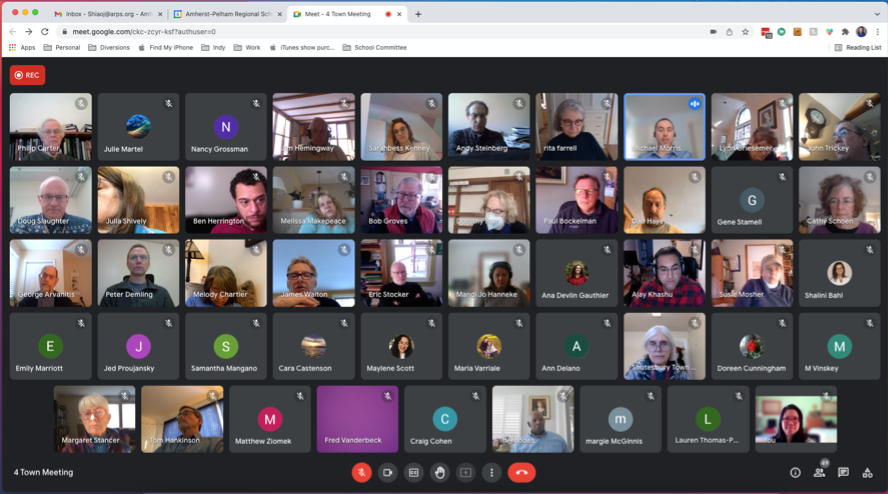
Over 50 people attended the January 8 meeting, and I figured out how to see them all on my screen at once in Google Meet!

Screenshot of Four Towns meeting on Google Meet.

The regional school district (Amherst Regional Middle School and Amherst Regional High School) is funded by the four towns, with each town contributing an amount based on a formula. The commonwealth of Massachusetts dictates a formula that is referred to as “the statutory method.” This method takes into account each town’s “ability to pay” which is based on property values in the town. Despite the fact that “statutory” means required, a region can choose to use a different method, as long as all participating towns agree (it also needs to be approved by the commissioner of elementary and secondary education). The state refers to any other method as an “alternative method.” Here at ARPS we refer to our alternative method as “the regional agreement.” If a region uses anything other than the statutory method, it must be voted on every year (even if it’s the same as the prior year), and all four towns must vote in favor. This is a critical part of passing the budget.

For many years now there has been tension between using the state’s statutory method or our custom “regional agreement,” which is based on student enrollment (five-year rolling average of students enrolled from each town). 

Between 2008 and 2016, the “regional agreement” was used; in 2017, the four towns agreed to use a mix of the two methods: 30% by the statutory (ability to pay) method and 70% by the regional agreement (student enrollment) method. The goal was to slowly increase the % statutory method to ease the transition of changing formulas. For FY22 the formula is 65% statutory and 35% regional agreement.

Confused yet? Me too. Basically, the way I think about this is that for some towns, it’s better for them if they pay an amount based on their property values, and for other towns it’s better for them if they pay an amount based on the number of students they send to the regional schools. Right now, the assessment method (that is, the formula used) is a combination of the two (65/35).

Doug Slaughter, the ARPS finance director, presented various formula options, from 55% statutory to 100% statutory. Representatives from each town had the opportunity to speak and give their input. 

Andy Steinberg from the Amherst Town Council said that in the last five years (during the period that the % statutory portion of the formula has gotten bigger), Amherst’s contribution has gotten bigger while the contributions from the other three towns has gotten smaller. He implied that moving towards a greater % statutory is not sustainable for Amherst. He went on to say that people view Amherst as the big town with plenty of resources, but that 50% of property in the town is owned by UMass and other colleges, and another 30% is not taxable for other reasons, so a huge portion of town real estate is not taxable, and yet we have a sizable population that the town provides services for. This is not news to me, but I appreciated hearing it stated so simply. People think that high property values in Amherst mean that Amherst has plenty of money, but in fact a huge proportion of real estate within the Amherst borders does not bring in any property tax revenue.

A representative from Shutesbury said that their goal is to move to the 100% statutory method, which they believe is the most fair and equitable because it factors in the “ability to pay.” Interestingly, this is the option that would result in Shutesbury paying the least amount, among all the options. A representative from Leverett said that they prefer the regional agreement method because it is based on a dollar contribution per student from that town. The Leverett person said they feared if Amherst could not shoulder the burden of the statutory method, that the quality of education would suffer. Similarly with Shutesbury, Leverett’s preferred option is one of the lowest in terms of the total amount Leverett would pay.

I spoke up and suggested an exercise whereby representatives from each town would pretend to represent another of the four towns, and go through the process of determining the optimal formula from that other town’s perspective, in an effort to get people to see things from someone else’s perspective. 

This discussion will continue as the budget process unfolds in the coming weeks and months.

Visioning of elementary education in Amherst

There are two Zoom workshops coming up that will allow community members to give input and participate in the visioning of the future of elementary education in Amherst, including goals and priorities for the new elementary school building.

Email me for the Zoom link (jennifer [at] jenniferamherst [dot] org).

See the January 7 Superintendent’s update email, or check out the event listings below:

Jan 13, 8:30 – 11:30 AM
https://www.facebook.com/events/4449258331866533?ref=newsfeed

Jan 26, 6:00 – 9:00 PM
https://www.facebook.com/events/494635375355611?ref=newsfeed

Amherst has two school committees?

I thought it would be helpful to have a short primer on school committees in Amherst.

Every two years (in odd-number years), Amherst voters elect five School Committee members to two-year terms. All five seats are up for election at the same time, in the same election as other town offices, such as Town Council and Library Trustee.

These five officials make up the Amherst School Committee, the body that oversees Amherst’s three elementary schools: Crocker Farm, Fort River and Wildwood. This body meets around once per month, and has a chair, a vice chair, and a secretary*. (The Pelham, Leverett, and Shutesbury elementary schools are not under the purview of this body; those towns have their own school committee for their elementary school.) The Amherst School Committee is sometimes informally referred to by people as “the elementary school committee.” (To further complicate matters, there is also an Elementary School Building Committee, which is a different body.)

The five Amherst School Committee members are also members of the Amherst-Pelham Regional School Committee. This body oversees the Amherst Regional Middle School and the Amherst Regional High School. Because these two schools also draw students from Leverett, Pelham, and Shutesbury, the Regional School Committee also includes members from those three towns (one each from Leverett and Shutesbury, two from Pelham), for a total of nine members. This body meets around twice per month, and has a chair, a vice chair, and a secretary (the secretary is typically a note-taker who is not a member of the committee).

The Amherst School Committee makes decisions on issues affecting the three elementary schools, and the Regional School Committee on the middle school and high school. For district-wide policies that affect both the elementary and middle/high schools, votes may have to be taken in both school committees. That’s why sometimes you may hear about an upcoming vote taking place and you think, Wait didn’t that vote already happen? It may be because it was voted on in one school committee, and then has to be voted on in the other. The school committees hold separate meetings.

* Further confusing this issue is the Union 26 School Committee, which is made up of the chair, vice chair, and secretary of the Amherst School Committee, and three officers from the Pelham School Committee. The Union 26 School Committee is tasked with employing the superintendent jointly with the Regional School Committee.

Clear as mud, right? If you’re confused, don’t worry – you’re not alone. Everyone finds it confusing at first; it took me several years of reading news, watching meetings, and asking questions, before I figured it out!