This blog reflects my own views about the Amherst and Amherst-Pelham Regional School Committees – it does not represent the view of the committees, the district, or the superintendent. This blog complies with Open Meeting Law, as long as a quorum of School Committee members do not engage in deliberations in the comments. Comments are welcomed; commenters must register with their name and email address (email address will not be published). I may respond to comments, but I will not respond to all comments. Sign up using the "Follow blog via email" form to be notified when I post a new entry.
With the start of the 2026-27 school year, the Amherst Elementary School District will look quite different from what it looks like today. Two significant changes will be implemented:
All 6th grade students in Amherst will attend school at the Amherst Regional Middle School (ARMS). It’s important to note that these students will not be enrolled at ARMS; rather, they will be Amherst Elementary students who will attend school in the ARMS building.
The Wildwood and Fort River school buildings will be closed, and in their place a new school building will open on the Fort River site, which will hold students in grades K through 5. The Crocker Farm school will remain in operation, also as a K through 5 school (plus the Early Education Center preschool).
Both the 6th grade school and the new school need school names! The Amherst School Committee plans to decide on the names for these two schools at our meeting on December 16. A Naming Subcommittee has recommended five finalist names for each school. The school community (parents/caregivers, staff, students, and community members) is invited to give input on the finalist names. While the final decision on the names rests with the Amherst School Committee, we would like to get input from the school community before making our decisions.
Please use this form to give your input on the finalist names for the two schools. The form will be open until 11:59 PM on Thursday, December 11.
With the start of the 2026-27 school year, the Amherst Elementary School District will look quite different from what it looks like today. Two significant changes will be implemented:
The Wildwood and Fort River school buildings will be closed, and in their place a new school building will open on the Fort River site, which will hold students in grades K through 5. The Crocker Farm school will remain in operation, also as a K through 5 school (plus the Early Education Center preschool).
All 6th grade students in Amherst will attend school at the Amherst Regional Middle School (ARMS). It’s important to note that these students will not be enrolled at ARMS; rather, they will be Amherst Elementary students who will attend school in the ARMS building. More information about this topic will be available in the coming months.
As a result of this restructuring, the district needs to define the boundary zones for the new school and for Crocker Farm. It’s not quite as simple as combining the current Wildwood and Fort River zones for the new school, and keeping the Crocker Farm zone the same as it currently is, for two main reasons:
Crocker Farm will be taking a slightly larger portion of K-5 students than it currently has.
The current boundary zones include two “islands” within the Crocker Farm zones – these islands are two apartment complexes that are zoned to Wildwood and Fort River, despite being within the Crocker Farm zone. The decision to create these two islands was made by the School Committee in place when these zones were determined.
The district has engaged Tim Ammon from Ammon Consulting, a firm with a great deal of experience in this type of work for school districts, to propose new boundary zones. Here is the latest draft proposal of the boundary zones from Ammon, from the October 24 Amherst School Committee meeting: https://go.boarddocs.com/ma/arps/Board.nsf/goto?open&id=DMH3CB062D92
See slide 6 for a map which displays the current and proposed boundaries. The thick black lines represent the current boundaries – the northwest zone is Wildwood, the east zone is Fort River, and the southwest zone is Crocker Farm. The large colored areas represent the latest proposed boundaries for the new school and Crocker Farm. Some important things to note:
The superintendent has stated that any students who would be affected by these boundary changes will have the option to remain in their current school, and younger siblings will be handled on a case-by-case basis.
The peach and light blue areas inside the Crocker Farm zone (purple) are the “islands” which are currently zoned to Wildwood and Fort River. In the proposal, these islands would change to be zoned to Crocker Farm. (They are colored on slide 6 in order to highlight them, but they are Crocker Farm/purple.)
The area just north of the purple/Crocker Farm zone are streets/neighborhoods which are currently zoned to Crocker Farm and would change to the new school. This area includes all of the side streets between Amity St. and Northampton Rd (Rte 116/9). It also includes Woodside, Hitchcock, and Snell St. and side streets.
Another change would occur on the northern portion of the border between Crocker Farm and the new school. Some homes along Southeast St., as well as Valley View Circle and Valley View Dr., are currently zoned to Fort River, and would change to Crocker Farm.
Whenever new zones are proposed, it’s important to look at the resulting demographic makeup of the schools. The main categories of demographics that we can look at are: race/ethnicity, presence of IEP (individualized education program), English language learner, and economically disadvantaged*. It’s important to note that no group is a monolith, and within every group of people that have a common characteristic there is a wide spectrum of ability, resources, needs, and more.
*”Economically disadvantaged” is a measure defined by DESE (Department of Elementary and Secondary Education) based on a student’s participation in one or more of the following state-administered programs: the Supplemental Nutrition Assistance Program (SNAP), the Transitional Assistance for Families with Dependent Children (TAFDC), the Department of Children and Families’ (DCF) foster care program, and MassHealth (Medicaid).
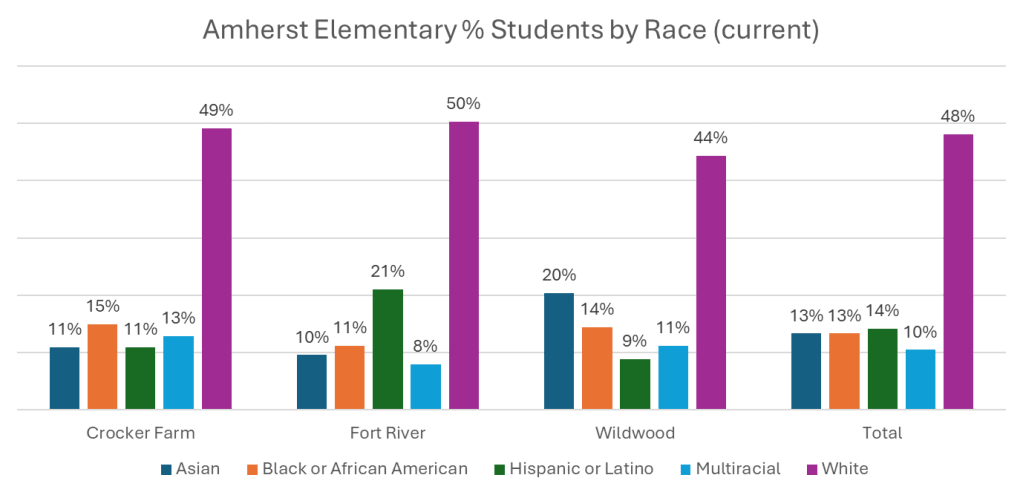
First, let’s talk about race/ethnicity. Here is the current make-up of our three elementary schools as well as the total elementary district.
Each bar represents the % of students in that category in that school. For each school and the total, the figures add up to 100 (could be one point off due to rounding). Here are some things that I see when I look at this data:
Around half of our elementary students are White. This is slightly lower in Wildwood, where there is a higher portion of Asian students.
At Fort River, Hispanic or Latino students represent 1 in 5 students (21%), which is higher than the overall figure of 14%, likely due to the presence of the Caminantes program in that school.
At Wildwood, Asian students represent 1 in 5 students, which is higher than the overall figure of 13%. My best guess is that this is likely due to UMass family housing in the Wildwood zone, which may skew towards more Asian graduate students.
Our schools are not identical when it comes to racial make-up, and each has its own personality and strengths.
Here is the projected make-up of students in Crocker Farm and the new school, based on the current student population and the latest boundary proposal:
It’s important to note that this data reflects the assumption that all students who would be affected by the new boundary proposal would opt to stay in their current school. In reality, we don’t yet know how many or which students will opt to carry over in their current school. Please also note that these figures are different from what was reported in the Ammon presentation from the October 24 Amherst School Committee meeting; the figures in that presentation did not account for carry-over students.
There are still variances between the two schools:
The new school would have a larger portion of Hispanic or Latino students than Crocker Farm, again likely due to the presence of the Caminantes program.
The new school would have a larger portion of Asian students (14%) compared to Crocker Farm. Again, my best guess is that this is due to UMass student family housing in the zone for the new school.
Crocker Farm will have a larger portion of Black or African American students than the new school, by 2 percentage points.
Next, let’s look at three important categories: Students with IEPs, English language learners (ELL), and economically disadvantaged (ED) families.
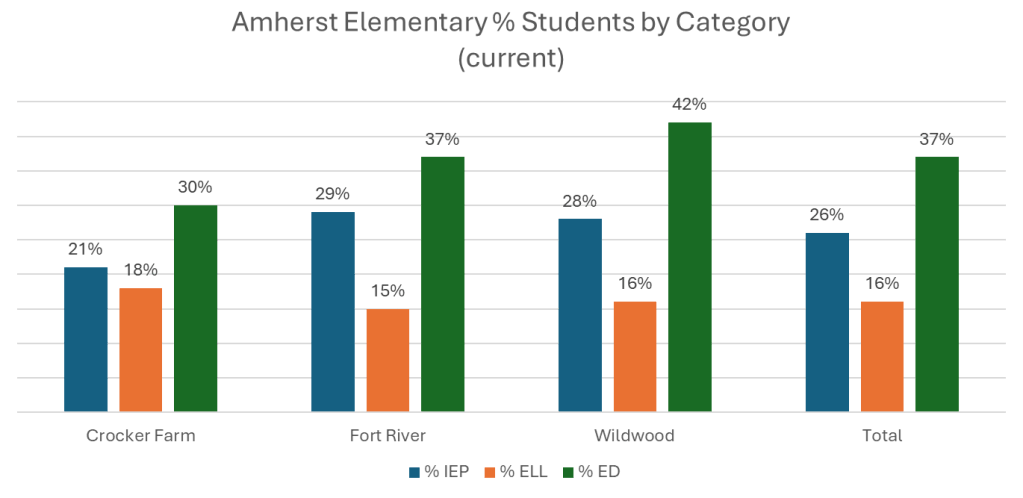
Here is the current make-up of our schools:
Each bar represents the % of students in that category in that school. Unlike the race/ethnicity data, the bars do not add up to 100%; the same student can be counted in more than one category and some students are not captured in any of the categories.
What this data tells me is that we currently have variances in these groups of students at our three schools.
At Wildwood, there is a larger portion of students from families designated as “economically disadvantaged.”
At Crocker Farm, there is a smaller portion of students with IEPs, likely due to the presence of specialized special education programs at the other schools.
At Crocker Farm, there is also a larger portion of English language learners.
Yet again, our schools are not identical when it comes to these categories, and each has its own personality and strengths.
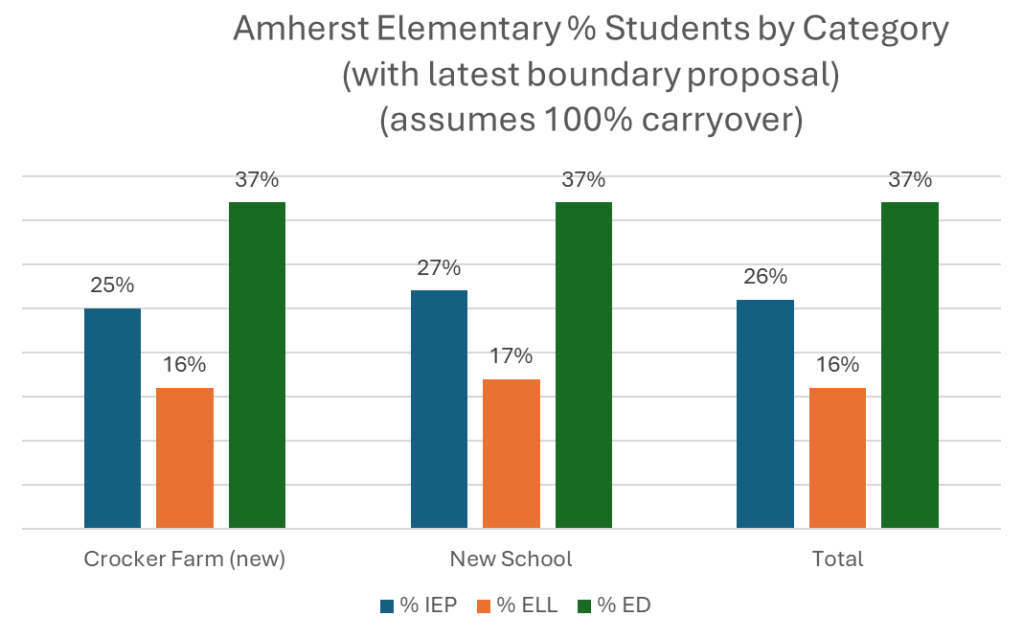
Here is the projected make-up of students in Crocker Farm and the new school, based on the current student population and the latest boundary proposal:
Again, it’s important to note that this data reflects an assumption that all students who would be affected by the new boundary proposal would opt to stay in their current school. In reality, we don’t yet know how many or which students will opt to carry over in their current school.
When comparing each category between Crocker Farm and the new school, the projected compositions are more similar than currently.
So what does all of this mean and where does it leave us? Here is my current thinking:
We know that we need to define boundary zones for the new school and Crocker Farm.
Ideally, we would do this in a way that impacts as few students as possible – meaning that we minimize students changing schools. This is partially addressed by the superintendent’s announcement that any student who would be affected by the new boundary zones can opt to stay in their current school (and younger siblings would be handled on a case-by-case basis).
Ideally, we would not continue to have “islands” of students sent to a school outside their zone. In my opinion, carving out islands within one school’s boundary zone, in order to create some desired “balance” is not a best practice, and it may marginalize the students in the islands.
Essentially, we need to draw one unbroken line through our town, in order to create two school zones, with the number of students in each zone aligning with the schools’ capacities. The chances of doing that AND having the two schools be identical in demographic make-up are pretty low. That being said, it’s my opinion that the latest boundary proposal gets pretty close.
Bottom line – the latest boundary proposal minimizes the number of students affected by the new zones AND results in two schools that are pretty similar in their demographic make-up. Said another way – the variances in the demographics between the two schools is acceptable, imho.
The reason for the rescheduling is that, per MA Open Meeting Law, School Committee meetings need to be publicly posted 48 hours in advance (not including weekends and holidays). For the Amherst School Committee, the official posting location is the Town of Amherst’s online calendar. In the case of the March 18 meeting, the ASC chair (me) neglected to post the meeting in the official location. So, the meeting has to be postponed at least 48 hours, so that it can be publicly posted (which it now is).
FYI, since the Regional School Committee is not within the Town of Amherst, the Regional School Committee’s official posting location is BoardDocs, the meeting website/platform for the three School Committees (Amherst, Pelham, Regional)
We are in the midst of budget season for the 2025-26 fiscal year (FY26), and I wanted to share some information about the process and timeline of developing and approving the budget for the Amherst elementary school district. (This does not apply to the Regional School District, which has a related but different process.)
WHAT HAS HAPPENED ALREADY?
12/20/24 Amherst Town Council sent budget “guidance” to the town manager, ARPS superintendent, and library director. This guidance indicated that the Town Council could support a 3.5% increase in operating budgets for FY26. (The original guidance was 3.0%, and then it was revised to 3.5%.) This works out to $27.9 million for the Amherst elementary schools for FY26.
Jan-Feb The superintendent and district staff developed a budget proposal that meets that guidance. For a “level services” (i.e. no cuts or additions) budget, the Amherst elementary district needs $29.5 million. The difference between this and the guidance number means that $1.56 million needs to be eliminated in order to meet the town’s guidance. The superintendent developed a proposal that would cut $1.56 million in spending (mostly by cutting positions and programs).
2/27/25 Public Budget Hearing This was the first time the superintendent’s proposed budget was presented to the public and the School Committee, along with an explanation of what the proposed cuts would mean for students, staff, and the district. The purpose of this meeting was to get input from the public. In this meeting, many members of the public spoke about their opposition to the budget cuts, and urged the Amherst School Committee to reject the proposed budget.
WHAT HAPPENS NEXT?
3/18/25 The Amherst School Committee will meet to discuss the proposed budget as a committee for the first time. At this meeting, School Committee members can ask questions and give input to the superintendent on whether or not they can support the proposed budget. For example, School Committee members can indicate to the superintendent that they could only support a budget with specific elements added back in. It is expected that the superintendent will take the School Committee’s input and work with her staff to revise the budget proposal.
3/26 or 3/27/35 The Amherst School Committee will meet again with the intention of voting on the revised budget proposal. The superintendent would present the revised budget proposal, and the committee would discuss and deliberate on it before voting. The School Committee CAN vote a budget amount that is higher than the 3.5% ($27.9 million) guidance provided by the Town Council.
By April 1 Per section 5.4 of the Amherst Home Rule Charter (the bylaws that dictate how our town is governed), the Amherst School Committee needs to submit the approved budget to the town manager by April 1. According to the charter, the town manager then submits a proposed town budget to the Town Council by May 1. The charter indicates that the municipal, school, and library components of the budget shall be “determined by the Town Manager.” This means that the town manager is not obligated to use the amount approved by the School Committee. The town manager is permitted, per the charter, to decide what amount to include for the school district in the town budget.
Town Council Next Steps Per the charter, the Town Council would immediately refer the town manager’s proposed budget to the Finance Committee. The Finance Committee would then hold a public hearing on the town budget (with at least 10 days’ notice). Within 30 days of referral, the Finance Committee would make a recommendation about the budget to the Town Council.
By June 30 The Town Council needs to approve a town budget by June 30. Per the charter, the Town Council can not increase the total amount of the budget or any line item. For example, if the town manager’s proposed budget includes only the 3.5% increase for the Amherst elementary district (thus forcing the district to make drastic budget cuts), the Town Council is not permitted to increase the amount for the school district. The Town Council CAN vote down the town manager’s proposed budget. If the Town Council does reject the town manager’s budget, my understanding is that the town manager would need to re-submit a budget (either the same one, or a revised budget) and attempt to get it passed again. This would continue until a budget is approved.
First, if you aren’t already familiar with the fact that Amherst has two school districts (with two separate budgets), hop on over to this blog post I wrote a few years ago: Amherst has two School Committees?
As the recently elected chair of the Amherst School Committee, I am working closely with the superintendent’s office on the Amherst Budget Hearing. The “Budget Hearing” is an annual public meeting during which the proposed budget for the following year is presented, and members of the public can make comments and ask questions. This public meeting comes in advance of the Amherst School Committee voting on the budget, so it is a key time for the community to make their voices heard to the School Committee about the budget.
For FY26 (7/1/25 – 6/30/26), the Town of Amherst has indicated that they can provide funding that reflects a 3.5% increase over the previous year. However, a “level services” budget for the Amherst elementary school district would require 8.5% more in funding compared to last year. “Level services” means that the school district would not add any programming and not cut any programming. In other words, in order to maintain the same level of services for the next school year, an increase of 8.5% is required in funding, yet the Town of Amherst has indicated that they can only provide 3.5% more in funding. The difference between what the town has said it will provide and what the school district needs amounts to around $1.3 -$1.4 million.
One week prior to the February 27 Budget Hearing, the budget presentation and the full line-item budget will be attached to the meeting posting. These documents will provide details on how the district plans to address the shortfall.
I know that next week is February school break, and families may have plans and may not be paying attention to the school budget right now. But time marches on and the Amherst School Committee has deadlines we need to meet regarding approval of the budget, so that the Amherst Town Council can meet their own budget deadlines. My advice is to check the meeting posting after February 20 (Thursday of February break), to view the budget presentation and see what cuts will be proposed. Then, make plans to attend the February 27 Budget Hearing (6:30 pm start; in-person or virtual) to give the School Committee your input.
I am pleased to report that at our June 25 meeting, the Regional School Committee (RSC) unanimously approved “Option 3C” for the ARHS Track and Field project. This option would re-orient the track to a north-south layout, create a natural-grass regulation-sized field inside the track, and provide an additional natural-grass field adjacent to the new track and field. In addition, the completed project would meet the necessary regulations to hold a track and field meet, and be ADA accessible.
The district has not yet secured the total funding required for this project (around $4.1 million), however the process can proceed by having a number of “Add Alternates” – items that can be delayed to allow funding to be secured at a later date. The Add Alternates proposed include lighting, curbing and sidewalk, ball safety netting, and reducing the scope of the fencing. This memo from Interim Superintendent Doug Slaughter lists the Add Alternates, as well as the motion that was passed by the RSC.
The RSC strongly urged the interim superintendent to pursue CPA (Community Preservation Act) funding from each of our four towns (Amherst, Leverett, Pelham, and Shutesbury).
According to the current project schedule, construction of the track and field is expected to completed by fall 2025.
On Friday, May 17, the Regional and Union 26 School Committees both voted unanimously to approve the superintendent contract for Dr. E. Xiomara Herman. The three-year contract will begin July 1, 2024, and includes a salary of $176,500 for the first year; salary for the subsequent two years will be negotiated. Also included is reimbursement of up to $9,500 for relocation expenses.
Dr. Herman was selected by the joint committees on April 29, after an extensive search process that included a 19-member search committee made up of community members, multiple opportunities for public input and for the public to meet the finalists, and a two-day visit from the finalists.
Dr. Herman is currently the insular superintendent of the US Virgin Islands Department of Education. Her CV and other information can be found on the Superintendent Search webpage.
I personally am very pleased with our decision to appoint Xiomara Herman. I think she has the potential to transform our district in really positive ways. People who met her spoke of her warmth and ease in connecting with people. Her experience, expertise, and focus on being student-centered make her a great fit for our district. I look forward to welcoming her to our district and our community.
At our April 23, 2024 meeting, the Amherst School Committee determined that Amherst 6th grade students will attend a “6th Grade Academy” in the Amherst Regional Middle School (ARMS) building, beginning in the fall of 2026. This means that Amherst 6th graders would be students of the Amherst elementary school district, and they will attend school in the ARMS building; these students would not be enrolled in ARMS. Confused? Don’t worry, you’re not alone.
First, some background. There are three elementary schools (Crocker Farm, Fort River, Wildwood) in the Amherst School District, serving students through grade 6. At the secondary level, the town of Amherst is part of the Amherst-Pelham Regional School District, which also includes the towns of Pelham, Leverett, and Shutesbury. The Amherst School District and the Amherst-Pelham Regional School District are two different school districts. The former is a municipal school district (serving the town of Amherst) and the latter is a regional school district (serving four towns).
In Massachusetts, regional school districts are governed by an agreement that is signed by the towns involved. The regional agreement for the Amherst-Pelham Regional School District has been in place for several decades, and provides for the four towns to send their 7th – 12th grade students to Amherst Regional Middle School and High School.
When discussion first began of moving Amherst 6th graders to ARMS (due to overcrowding in our current elementary schools, and the opening of the new K-5 elementary school in fall ‘26), the question was raised as to whether Amherst 6th graders could be enrolled in ARMS; that is, could they be students of the Amherst-Pelham Regional School District? In order to do this, the regional agreement would need to be changed, to allow Amherst to send 6th grade students to the regional schools. (My understanding is that the other towns are not interested in sending their 6th graders to ARMS.) Changing a decades-old regional agreement is not easy or quick, and requires approval from DESE (the Massachusetts Department of Elementary and Secondary Education), so this is something that needed to be researched far in advance.
At the April 23 meeting, Interim Superintendent Doug Slaughter informed us that, not only would we need to change the regional agreement, we would also need special legislation at the state level, because “the statute regarding Regional School Districts requires all member Towns to participate in the Region with the same grade levels.” So, in order for Amherst to send 6th – 12th grade students, while the other towns send 7th – 12th grade students, legislation would be needed to allow us to override the statute.
He also shared that, after meeting with representatives from DESE several times, he learned that it is unlikely they would endorse the special legislation or changing the regional agreement.
After hearing that it is highly unlikely that Amherst 6th grade students would be able to be enrolled in ARMS, the Amherst School Committee came to consensus that Amherst 6th graders would attend a “6th Grade Academy” (this is the current/working name) in the ARMS building. We also all agreed that making this move in fall of 2025 is too soon, so the move would be made in fall of 2026.
Between now and then, there is a LOT to be done and decided! Here is a non-exhaustive list:
What will the 6th grade educational model look like?
How will Special Education services be delivered for 6th graders in the ARMS building?
Where in the ARMS building will the 6th grade students be located?
Which staff will move to the ARMS building?
What will the administrative model look like for overseeing the 6th Grade Academy?
Will 6th grade students use dedicated bathrooms in the ARMS building?
The Amherst School District will essentially be leasing building space from the Amherst-Pelham Regional School District. What will that lease agreement look like?
How will transportation schedules be affected?
Bottom line: This is happening! This year’s 3rd graders (students in 3rd grade in the 2023-24 school year) will be the first cohort to attend 6th grade in the ARMS building.
What questions, concerns, ideas, suggestions do you have? You can email the Amherst School Committee at AmherstSchoolCommittee@arps.org.
At our February 27 meeting, the Regional School Committee voted to approve the 2024-25 school calendar. The calendar includes the following:
First day of school for grades 1-12: August 26.
An extra long winter break, starting December 23 (last day of school before break, December 20, is a half day), until January 6 (first day of school after break is Tuesday, January 7).
Last day of school will be between June 17 and 25, depending on the number of snow days.
In a previous blog post, I had asked people to chime in with their preference between two calendar options. I received 54 emails and comments, with 35 being in favor of this option. In addition, the School Committee was informed at yesterday’s meeting that the APEA also preferred this option.
At the January 23 meeting of the Regional School Committee, we got our first look at the proposed calendars for the 2024-25 school year.
Below is a summary of the highlights of the two proposals*, alongside with the current calendar for comparison. (I suggest that you get out or open up a calendar, so that you can see the days of the week of these dates.)
Current 23-24 (Labor Day Sep 3)
24-25 Option #2 (Labor Day Sep 2)
24-25 Option #3 (Labor Day Sep 2)
First day of school (grades 1-12)
Aug 30
Aug 26
Aug 28
First day of school (preK and K)
Sep 5
Aug 28
Sep 3
Winter break
Dec 25-Jan 1
Dec 23-Jan 6
Dec 23-Jan 1
Last day of school (depending on snow days)
Jun 14-24
Jun 17-25
Jun 17-25
My initial thought is that Option #2 looks appealing because of the extra long winter break, which has Three King Days (Jan 6) tacked on at the end (starting Monday December 23, returning Tuesday January 7). That said, I’m concerned that families with child care needs would find it difficult to have kids out of school for an extra long time.
* Option #1, with a start date after Labor Day, was not considered feasible because it would push the potential last day of school (with five snow days) to July 1, which is prohibited by the Department of Elementary and Secondary Education. (Proposing a start date after Labor Day is required in our contract with the APEA, the union representing educators, paraeducators, and clerical staff.)
We will likely be choosing a calendar and voting on it at our February 27 meeting. Please share your perspective and input. Which schedule do you and your family prefer? Here are options for sending your input:

 Jennifer Shiao's School Committee Blog
You must be logged in to post a comment.