What’s happening? Meeting TONIGHT (Tuesday, May 16)

It’s been challenging, even for me, to keep up with what’s happening this week, when and where the meetings are, and what will take place.

Here is what I know:

  • There will be a meeting TONIGHT, Tuesday, May 16, starting at 5:30 PM in the library of the Amherst Regional High School (to access the library entrance after hours, go around to the east side of the building and enter through those doors).
  • This will a joint meeting of the Regional School Committee (RSC) and the Union 26 Committee (made up of three representatives from Amherst and three from Pelham). These two bodies make decisions about the superintendent role.
  • The agenda states that we will vote on going into Executive Session (a meeting not open to the public), then there will be public comments, then we will discuss appointing a temporary superintendent.
  • The chairs of the Regional School Committee and the Union 26 Committee have already stated that we will not discuss appointing a temporary superintendent in Executive Session. That discussion will happen in open session.
  • My guess is that the committees will not approve going into Executive Session, and that the entire meeting will be open to the public.
  • If you want to make a live public comment at the meeting, there probably will not be a sign-up list. You will probably just step up to the microphone when the Public Comment period opens. (I could be wrong about this; it’s possible the chairs will institute a sign-up list at the meeting. If that is the case, they will announce it at the start of the meeting.)
  • Here are three other ways you can provide pubic comment (do these before 3:00 PM today to ensure they will be included in the meeting tonight):
    Send an email to SCPublicComment@arps.org
    Send a text to 413-362-1891
    Leave a voicemail at 413-362-1891
    Emails and texts will be displayed at the meeting; voicemails will be played at the meeting.
  • If you would like to send an email on this topic that you do not want to be displayed as public comment at the meeting, I suggest that you send it to both RegionalSchoolCommittee@arps.org and PelhamSchoolCommittee@arps.org.

I hope to see you at tonight’s meeting!

I believe you and I believe in you

I stand in full support of LGBTQ+ students and staff at ARMS and throughout our school district, and all LGBTQ+ individuals. Anti-queer rhetoric, behavior, or bullying has no place in public schools, nor in a civil society. The information and stories reported in “‘It’s life or death’: failure to protect trans kids at ARMS a systemic problem” (en Español: “‘Es vida o muerte’: la falta de protección de los niños trans en ARMS es un problema sistémico“) are harrowing, heartbreaking, and enraging.

When people stand up and share about being bullied or mistreated, I believe them. When you tell me about how you were harmed by someone who was supposed to help, I believe you. When a mom says that she feared her child wouldn’t make it through the night without harming themself, I believe her.

I also believe in this community. I believe that we can insist on the changes needed to repair the harm that has been done to individual students and to our student community, and to ensure that the harm does not repeat or continue.

I invite you to attend the next meeting of the Regional School Committee, which is currently scheduled for Tuesday, May 16, starting at 6:30, in the Amherst Regional High School library (to access the library entrance after hours, go around to the east side of the building and enter through those doors). The meeting has not been posted yet, but when it is you will find it on the School Committee’s “Boarddocs” site. Public comment will probably be one of the first items on the agenda.

I want to hear about how these stories and reports have affected you and your family. Come to the meeting to support others in sharing their stories. If coming in person will not work for you, you can send an email to SCPublicComment@arps.org, or send a text or leave a voicemail at 413-362-1891. (Emails and texts will be displayed at the meeting; voicemails will be played. Emails, texts, and voicemails must be received by 3:00 pm on the day of the meeting.) You can watch the meeting live on Amherst Media .

I believe you, and I believe in you.

Why I’m super excited about the Amherst elementary school building project

On May 2, Amherst voters will decide on a Proposition 2 1/2 debt exclusion for a new elementary school to be located at the Fort River site, which will replace both the Wildwood and Fort River elementary schools.

I am super excited for this school building project! The thing that excites me the most is that this will be Amherst’s first net-zero municipal building. With geothermal wells for heating, ventilation, and air conditioning, as well as solar panels on the roof and parking lot canopies, this will be the first Amherst town building to NOT rely on fossil fuels! What a great model we are setting for our students – showing them that we invest in what we care about.

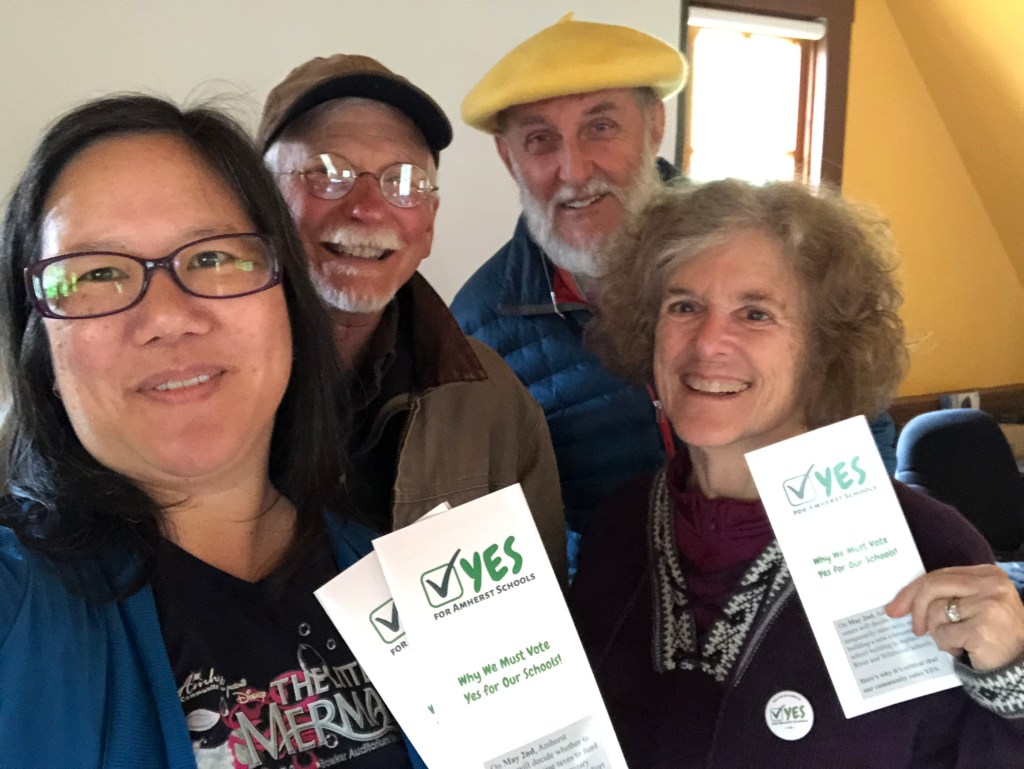
(Jennifer Shiao, Rudy Perkins, Bruce Coldham, and Cathy Schoen, canvassing for Vote Yes on April 23.)

Another thing that I’m excited about is that this building, and the fields and grounds around it, will be a community resource. From the cafetorium (combination cafeteria and auditorium) and gymnasium to the athletic fields (which are supported with Community Preservation Act funding), non-school organizations will benefit from the new school.

Lastly, the grade configuration of this new school keeps our kindergarten through 5th grade students in one building (Crocker Farm will also house K-5 students). Sixth graders will attend school at the Amherst Regional Middle School.

Voting yes on this project on May 2 means that our students and staff will have improved learning and working conditions, and will show how much this community values education.

Moving 6th graders to the middle school delayed to fall ’25 or fall ’26

At the February 16 meeting of the Amherst School Committee, the committee voted to delay moving 6th graders to the Amherst Regional Middle School building to fall of 2025 or fall of 2026.

Change to the original plan (to move 6th graders in fall ’23) was first proposed by Superintendent Mike Morris last month. At the Feb 16 meeting, Mike introduced the idea of delaying the move later than fall ’23, but possibly making the move sooner than fall ’26. He suggested that the School Committee might prefer to have some flexibility, given the ongoing space constraints at Fort River, which will not get any better in the coming years, and a new piece of information regarding the “regional agreement.”

The “regional agreement” is an agreement signed by the four towns in the Amherst Regional Public Schools district (Amherst, Leverett, Pelham, and Shutesbury). The agreement was signed decades ago and includes, among other things, the agreement that the Amherst Regional Middle and High Schools would educate students in grades 7 through 12. Because the regional agreement does not include 6th graders, the original plan was for the Amherst 6th grade students to attend a separate “6th grade academy” (essentially a school-within-a-school) housed in the middle school building, but not actually be enrolled in middle school.

In order for Amherst (or any) 6th graders to be enrolled in the Amherst Regional Middle School, the regional agreement would need to be modified. However, modifying a regional school district agreement is a lengthy and involved process that could take several years from start to finish. In recent meetings with DESE (the MA Department of Elementary and Secondary Education), Mike learned that the department is open to the idea of adding an amendment to a regional agreement without the need to take on the lengthy process of modifying the agreement. This would allow for integration of the 6th graders into the middle school, instead of the school-within-a-school model, and could be accomplished in a shorter time frame.

After discussion and debate, the School Committee voted to delay moving 6th graders to the middle school to fall ’25 or fall ’26, and to make that decision no later than November 2024. This means that this year’s 4th and 5th graders will not attend 6th grade at the middle school. The first cohort to attend 6th grade at the middle school would be this year’s 2nd or 3rd graders, with that decision to be made by November 2024.

This motion passed 3-1 as follows:
Shiao: Yes
McDonald: Yes
Demling: Yes
Rhodes: No
Herrington: Absent

You can watch the video of this discussion, which starts around 52 minutes into the meeting here: https://www.youtube.com/live/sG0YkiHUbQQ?feature=share&t=3121

Moving 6th graders to the middle school may be delayed to 2026

At the January 10 meeting of the Amherst School Committee, Superintendent Michael Morris shared reasons for considering delaying moving 6th graders to the middle school until 2026. The current plan is for Amherst students to attend 6th grade in the Amherst Regional Middle School (ARMS) building beginning this fall (2023).

The three buckets of reasons Morris gave for considering this change now are:

  • Fewer students than expected. The number of K-6 students in Amherst is lower than was expected when the plan to move 6th graders to the middle school was first developed. As a result of this lower enrollment, we will have three fewer sections (classrooms) in the three elementary schools in the next academic year than the current year (one fewer in Crocker Farm, two fewer in Wildwood, no change in Fort River). Thus the issue with lack of space at our elementary schools will not be as dire as expected.
  • We are projected to have a budget deficit of around $800,000 for FY24 (fiscal year ending 6/30/24). While we anticipated a deficit, we did not expect it to be this high. 
  • The complexity of running, essentially, a fourth elementary school in Amherst. Because the Amherst Regional Middle School is a regional school that does not include 6th grade, the Amherst 6th graders would, in essence, attend a separate school located in the ARMS building. We recently received confirmation from DESE (the MA Department of Elementary and Secondary Education) that we would need to operate a fourth elementary school, which comes with staffing and financial complexity.

The School Committee heard information on this topic at the January 10 meeting, but we did not discuss it in detail or deliberate on it, because it was not on our posted agenda for the meeting. The plan is for the superintendent to come back to the committee at our next meeting, which will be January 24, with more information including maps and budget implications.

To be clear, the district and the School Committee are still committed to moving 6th grade to the middle school; it is a question of WHEN not IF.

If you would like to share your input on this topic with the Amherst School Committee, you can email all committee members at AmherstSchoolCommittee@arps.org.

The School Committee failed to discuss the issue of PFAS in artificial turf

One of the responsibilities of a School Committee member is to support committee decisions. This is true even if you yourself did not vote with the majority. The School Committee operates as a single body, and individual members have the responsibility to support the decisions that the body makes.

But what if you did vote with the majority, and after the fact you learned new information that changes your perspective on the decision? That is the position I find myself in.

At the February 15, 2022 meeting of the Regional School Committee, we discussed a report from Weston & Sampson, an engineering and design firm, about the options for repairing or replacing the Amherst Regional High School (ARHS) track and field. The options included resurfacing of the running track (“Option 1”), re-orienting the running track to a north-south orientation and using natural grass for the interior playing field (“Option 2”), and the same as Option 2 but using synthetic turf (“Option 3”). We were informed that Option 3 is the most expensive, and also the preferred option of the district. 

Among the “Cons” of synthetic turf, the report stated “negative perception of environmental, human health risks, and injuries.” The report went on to note the following as “disadvantages” of synthetic turf:

  • Synthetic turf has been known to be more abrasive than natural turf, resulting in more turf burns to a player’s skin.
  • Synthetic turf has heat absorbing properties
  • Some people may view synthetic turf as a potential risk to players and the environment.

Unfortunately, no committee members raised concerns about these issues, and they were never discussed. In addition, the fact that the blades of grass in synthetic turf are manufactured with chemicals called PFAS (per- and polyfluoroalkyl substances), man-made “forever” chemicals that do not occur naturally and do not break down, was not mentioned and therefore not discussed.

Just one week prior to this meeting, on February 8, 2022, the Nantucket School Committee held a 1.5 hour workshop on PFAS in turf fields, during which they brought in members of the scientific community to talk about the risks to human health and the environment of PFAS.

At the time, my one concern about artificial turf was whether it was a “green” or environmentally friendly option. At the February 15 meeting, I asked if we could be provided with information about how green each option is in terms of the construction costs, the manufacture of artificial turf, and the maintenance moving forward. Unfortunately, my question was never addressed at future meetings, and I never brought it up again, which I admit is a failure on my part to follow through on a concern.

One month later, on March 15, the School Committee voted 8-1 to approve borrowing $1.5 million for the ARHS track and field project . All of the debate around the vote was about funding the project, with zero discussion on the environmental or health and safety impacts of artificial turf. No one brought it up, so we never discussed it.

Looking back now, I regret not doing my own research about my questions. Had I done a simple Google search on “how green is artificial turf” I would have turned up a dozen articles about the risks of artificial turf, including a report from just one week prior that the Nantucket Public Schools had decided to put on hold the plans for its athletic complex, due to concerns about PFAS in artificial turf.

Indeed, since that March 15 decision, more stories have arisen about MA school districts grappling with the issue of PFAS in artificial turf (see also Martha’s Vineyard, Malden, Boston, and Franklin). Each of these cases is different, with unique variables and decision-making bodies. However, in each case the topic was discussed and debated in public before decisions were made (except maybe Boston where Mayor Michelle Wu directed that no new artificial turf fields be installed in the city of Boston).

My big regret here is that the Regional School Committee never discussed the issue. We didn’t consult experts with differing opinions nor hear from members of the public about their concerns about the environmental and health impacts of artificial turf, as they did in Nantucket.

I did not do my due diligence to learn more about the “cons” of artificial turf. At least one of my fellow members shares my regret about not having educated ourselves before making the decision, and at least one other member implied at the November 17 Regional School Committee meeting that she was knowledgeable on this issue before voting. Regardless, we never talked about it, and that is what I regret – that we did not discuss this matter as a group, so that together we could make an educated decision.

But now that I know more, I can’t in good conscience support a decision that was made without the benefit of a robust discussion on some very important issues regarding artificial turf. Ultimately, a School Committee member’s job is to do what is in the best interests of students and the school community; the responsibility to support committee decisions should not take precedence over this.

School Committee votes to restore art and technology educator positions to full time (Amherst School Committee, 6/28/22)

At our June 28 meeting, the Amherst School Committee voted unanimously to restore the art and technology educator positions at all three elementary schools to full time, through funding from the school’s budget. You can read about the background of this issue in my March 29 blog post (Amherst School Committee restores art and technology specials teachers for FY23 budget – but how?) and my April 27 blog post (A “rounding error” sized problem with no solution).

To recap: The School Committee came up with a compromise solution for the $79,200 needed to restore the six 0.8 FTE (full time equivalent) positions to 1.0 each – use ESSER funds (COVID relief funds for schools) for one-third of the amount, and request more money from the town of Amherst for two-thirds of the amount.

On June 13, the Amherst Town Council did not approve the additional funds to cover these positions. (You can watch this portion of the Town Council meeting here.

At the June 28 School Committee meeting, Superintendent Mike Morris said that he sees the value in restoring the positions to full time. He suggested using funds in “the back of the budget,” i.e. the Control Account, to cover the amount needed for these positions. The Control Account is a budget line item where funds are reserved for expenses that are unknown at the time the budget is developed. Morris indicated that there are always funds for “one teacher and two paras” in the Control Account, in case extra staffing is needed, beyond what was planned for. Earlier in the meeting, he had presented an update on kindergarten registration, which indicated that fewer kindergarten sections would be needed than originally anticipated, resulting in a cost savings.

Morris said “My thinking [on these positions] has evolved as more data has come to me.” He did indicate that pulling the needed funds from the Control Account is a risk, but that it’s a risk worth taking for this year. 

It is unknown if the positions will be able to be funded the following year (23-24 academic year) or future years. When the new elementary school building opens (expected fall 2026), the district expects to see operational savings, which would change our financial picture.

I am very happy and grateful that these six positions (one art teacher and one technology teacher, at each of our three elementary schools) will be restored to full time for this year. This is the right thing for our students, who need art and technology now more than ever, in addition to the strong relationships formed between full-time educators and students. And it’s the right thing for our staff, who deserve our respect and commitment to full-time jobs. This was a stressful and lengthy process, and I wish we could have gotten here sooner, but I’m glad we got here in the end!

A “rounding error” sized problem with no solution (Amherst School Committee 4/27/22)

A month ago at our March 29 meeting, the Amherst School Committee unanimously approved a compromise solution to restore our art and technology specials teachers to full time. You can read about it in my blog post covering that meeting. Essentially, we agreed to cover the $79,200 needed to restore six 0.8 FTE (full time equivalent) positions to 1.0 position each through a combination of additional ESSER (Elementary and Secondary School Emergency Relief Fund) funds (an additional $26,400, which is one-third of the needed amount), and a request to the town of Amherst to increase our appropriation from the town (an extra $52,800, which is two-thirds of the needed amount).

Since then, Superintendent Mike Morris received an email from Town Manager Paul Bockelman (which Mike forwarded to the School Committee members) indicating that Paul would not include the extra amount we requested ($52,800) in his submission of the school budget to the Town Council. He went on to say that the Town Council can add the amount in, with a two-thirds vote of approval by Town Council members. He mentioned that the School Committee could adjust our budget request to remove the extra amount, and bring the total school budget in line with the town’s original budget guidelines.

What does all this mean? Basically, with our vote on March 29, the School Committee agreed to ask the town of Amherst for slightly more than the town had planned to spend on schools for the 22-23 fiscal year. The town had planned to allocate $25,052,500 to the school district for 22-23, and the School Committee asked for an extra $52,800 (for a total of $25,105,300). Paul’s email essentially puts this decision in the hands of the Town Council, who would need to vote with a two-thirds margin to approve the additional funds.

But we did have an opportunity at last night’s meeting to change our request to the town. We could have reconsidered our decision from March 29, and decide to cover the $79,200 entirely with ESSER funds, or shifting money from another budget line item, or a combination of both, in order to remove or lower the additional amount requested of the town.

Also, there was a new twist! Mike shared with us that we received “a little over $20,000” in one-time state funds that were granted to school districts who lost enrollment last year and gained enrollment this year.  (Inexplicably, this is referred to as “pothole money,” though it has nothing to do with potholes.) He said that the district plans to use those funds, “plus a little more because we are in good financial shape,” to prepay special education tuition for out-of-district students for next year, which will help next year’s budget (this is legal and commonly done). This means that the 1/3 ($26,400) voted on by the SC at the last meeting won’t have to be spent out of ESSER funds – we will be able to pay it out of our budget. 

This is good news, since there is strong community support for figuring out a way to restore the art and technology teachers to full time. At last night’s meeting we received one live comment, two voicemails, and 10 emails, all in support of using ESSER funds or finding a way to fund these positions within our budget, from community members and Amherst educators.

With all this information on hand, I made two suggestions:

  • I suggested that we shift $30,000 that is earmarked in the Contingency section of the budget for Professional Leave, and use that to partially cover the art and technology specials teachers. That line item, reserved for teacher sabbaticals, has had zero spent on it for the past four fiscal years. I am strongly in favor of teacher sabbaticals, but if it isn’t needed then there seems to be no reason to set it aside. In fact, Mike acknowledged that the deadline for educators to request sabbatical for FY22-23 has passed, and there have been no requests.
  • I also suggested that we do what we agreed to at the March 29 meeting, and spend the additional $26,400 of ESSER funds. If we do this on top of the plan for the one-time state funds, that would cover two-thirds of the $79,200 needed to restore the art and technology teachers. 

If we agreed on both suggestions above, then we would fully cover the needed amount! If we could agree to one but not both, then we could lower the extra amount requested of the town (we could request an additional $26,400 instead of an additional $52,800), and make it easier for the Town Council to approve our request. However, my ideas did not gain any traction with the other School Committee members. Members expressed a desire to stick with the decision we made at the March 29 meeting, a desire to keep the $30,000 in case someone does request a sabbatical, and discomfort with using more ESSER funds on staff salaries.

I made a motion to reduce the additional amount in appropriations that we made of the town by $26,000, which was seconded by Peter Demling. The motion failed with all other members present voting against (Allison McDonald, Peter Demling, Ben Herrington), and only me voting in favor (member Irv Rhodes was absent).

I agree with Fort River educator Nicole Singer, who said in her public comment last night, “We have them [ESSER funds] so that we can use them for what students need. If it’s between using grant funding and not restoring the positions at all, I’ll take it.” Piecing together a patchwork solution that is not guaranteed past one year is not ideal, but if it’s between that and not restoring the positions at all, I’ll take it!

In addition, I feel that by requesting additional funding from the town for these teacher positions, and placing the decision in the hands of Town Council members, we are passing the buck. Now, those who advocated to the School Committee for finding the funds to cover the positions will have to advocate to the Town Council. We are ceding our decision making to the Town Council, which feels irresponsible to me. I’m not against the idea, in theory, of requesting more from the town than the guidance we were given, but to make teacher salaries contingent on the decision makes me deeply uncomfortable. I feel that we are failing our students and our educators, who have so clearly stated how important these positions are, by passing the buck.

I’m disappointed that we could not agree on a solution to this “rounding error” of a problem. $26,400, or $52,800, or $79,200 … these figures are so small in the context of our $25 million budget – we’re talking tenths of a percentage point. And yet, these positions are so impactful to our students and our school community. It seems all we can do now is advocate to the Town Council, for two-thirds of them to vote in favor of approving the additional amount requested by the School Committee. I hope you’ll join me. You can find contact info for the Town Council here.

Amherst School Committee restores art and technology specials teachers for FY23 budget – but how? (Amherst School Committee meeting 3/29/22)

Siblings of students in special education programs will be offered to attend the same school, but no guarantee of transportation.

At the Amherst School Committee meeting on March 29, 2022, the committee voted unanimously to restore the art teacher and technology teacher positions to 1.0 FTE (full time employee) per school. These six positions (one art and one technology teacher at each of our three elementary schools) had been reduced to 4.8 FTEs for the 21-22 school year, and the plan was to have teachers from Wildwood and Fort River cover sections at Crocker Farm on a part-time basis, while still teaching the same number of sections in their home school. This resulted in less prep time and more stress for those teachers. The committee received public comments and emails from several educators and many community members, urging the restoration of these positions. Perhaps the most poignant was from Fort River technology educator Trevor Takayama: 

“If I have to teach my full load of classes at one school and add on another 20% (5 classes) at another school for the second year in a row… then I am quitting the 20% part next year and I’ll take a paycut for teaching my full load in 4 days. I am exhausted from the added workload.”

You can read the submitted public comments on the Boarddocs site for the March 29 meeting.

The amount of funding needed to bring the 4.8 FTEs up to 6.0 was pegged at $79,200. In my view, this is a relatively small number (in a $25 million budget) that has a very large impact. As one parent said, 

“It shouldn’t have to be said that our students desperately need consistency and support for arts integration and technology. We have already lost fabulous educators because of the budget cuts. It is critical that the district prioritize arts education, and technology education.”

The original FY23 (‘22-’23 school year) budget proposed to the School Committee did not include restoring the positions to full time. When I asked, at the March 8 meeting, what the budget would look like if these positions were restored to full time, Superintendent Mike Morris immediately responded that the funds could be pulled from ESSER funds (Elementary and Secondary School Emergency Relief Fund, a temporary federal COVD relief program). The proposed budget already included $393,531 in ESSER funds to “support the budget.” That is, it had already been proposed to use these temporary funds for operational costs. Morris suggested on March 8 that we could pull the additional $79,200 by increasing our usage of ESSER funds.

However, at the March 29 meeting, Morris stated that he did not think it was a good idea to use these temporary funds for the specials teachers. The funds will be available for one more year after this one (FY24), and after that we will fall “off the cliff” of temporary funds – that is, those funds will no longer be available and we will have to figure out how to cover that amount.

Much discussion ensued about the advisability of using a higher amount of ESSER funds ($472,731, as opposed to the $393,531 originally proposed). Several other school committee members were uncomfortable doing this, and did not want to use temporary funds to cover salaries. However, I felt that, since we were already going to do that – we were already going to use almost $400,000 in ESSER funds to cover staff salaries, and since we have the funds available this year and next year, why wouldn’t we use them?

School Committee member Peter Demling brought up the idea of requesting a higher appropriation amount from the town of Amherst in order to cover the $79,200. (Brief background: The town gives the school district guidance as to how much the school district can spend in the next fiscal year. Typically, the school district works within that guidance. The amount the town allocates to the school is called the “appropriation.”) Finance Director Doug Slaughter responded that the school committee *can* approve an appropriation amount that is higher than the guidance given by the town. It will then be up to the town to approve that amount or not.

I did not think it was a good idea to request an appropriation amount higher than the town’s guidance, in order to fund the art and technology specials teachers at full time. To me that feels like “passing the buck” to the Town Manager and Town Council to decide whether or not to fund these positions, instead of the School Committee making the decision. But in an effort to compromise, I proposed splitting the difference – what if we fund half of the $79,200 with ESSER funds and half through town appropriation? 

In the end, we landed on a one-third ESSER/two-thirds town appropriation model. One-third of the $79,200 ($26,400) will be pulled from additional ESSER funds, and two-thirds ($52,800) will be added to the total amount we will request in appropriation from the town. I don’t love this plan! But it was super important to me to get the specials positions restored to full time, so I voted in favor of it. It remains to be seen if the town will agree to the higher appropriation amount.

Later in the same meeting, the School Committee discussed the policy of allowing siblings of students in one of the three district-wide special education programs to attend the same school. The AIMS (Academic Individualized Mainstream Support) and Building Blocks programs are located at the Fort River School; the Intensive Learning Center program (ILC) is located at the Wildwood School. Students enrolled in these programs go to the designated school, even if they do not live in the defined enrollment area for that school. This can result in siblings attending different schools. SEPAC (Special Education Parent Advisory Council) sent a public comment strongly urging the School Committee to allow siblings of students in these specialized programs to attend the same school:

“The shared experience of school for siblings, both disabled and non-disabled, is an important part of growing up. At present, families of non-disabled children have the luxury of being together at school. Our special education students and their families deserve the same.”

The committee chair informed us that the decision had already been made, last year, to allow this, but it had not been implemented yet. It is unclear why it had not been implemented.

The School Committee then heard from the superintendent about the potential challenges of providing transportation to school for siblings of special education students. He talked about vans being filled to the brim already, and bus drivers being in short supply. 

I pointed out that there are around 40 students in the specialized programs (a number that fluctuates year to year, but has been around 40 for several years). Some of those students already attend their home school, some do not have siblings of elementary age, and some families may not want the sibling(s) to attend the same school (for any number of reasons). The number of siblings whose families would take advantage of this could be very low. Still, the superintendent was uncomfortable guaranteeing transportation for siblings. The school committee discussed the inequity of offering the choice for siblings to attend the same school but not guaranteeing transportation – only families with the resources to have private transportation and the time to drive their student to school will be able to take advantage of this. Still, I did not want to hold back on offering this to families. I do hope that, in the end, transportation will be made available to all families who participate in this.
Regional School Committee approves high school track and field project (Regional School Committee meeting 3/15/22)

Last night in an 8-1 vote, the Regional School Committee (RSC) approved a motion to approve borrowing $1.5 million for the ARHS track and field project: 

MOTION: Move that the District appropriates the amount of One Million Five Hundred Thousand Dollars ($1,500,000) to pay costs of resurfacing the existing track, relocating field events areas, improving access to the existing facility, installing perimeter fencing and pathways systems to provide ADA accessibility to the existing track, and for the payment of all other costs incidental and related thereto, and that to meet this appropriation the Treasurer, with the approval of the Chair of the School Committee, is authorized to borrow said amount under M.G.L. c. 71, §16(d), or pursuant to any other enabling authority, and to issue bonds or notes of the District therefor. Any premium received upon the sale of any bonds or notes approved by this vote, less any such premium applied to the payment of the costs of issuance of such bonds or notes, may be applied to the payment of costs approved by this vote in accordance with Chapter 44, Section 20 of the General Laws, thereby reducing the amount authorized to be borrowed to pay such costs by a like amount. In the event that the Committee should determine, on or before January 16, 2023 that at least $2,200,000 has been raised through other sources, including but not limited to, Community Preservation Act Funds contributed by member towns of the District, American Rescue Plan Act funds, grants from the Commonwealth or from any other sources whatsoever, then the amount authorized to be borrowed by this vote shall be applied, instead, to pay costs of relocating the track to a north/south orientation with a synthetic  playing field interior, relocating the field events area to adjoining field space, improving access to the facility, installing perimeter fencing and pathways systems to provide ADA accessibility to the track facility, new field lighting and irrigation facilities, and for the payment of all other costs incidental and related thereto.

The wording of the motion is confusing, due to legal requirements when a body approves borrowing. It essentially says this:

A. The RSC approves borrowing $1.5 million, which will be the responsibility of the four towns according to a predetermined formula (each town will take on a portion of the debt), for a project to resurface the ARHS track, as well as other improvements such as providing ADA accessibility.

AND

B. If, by January 16, 2023, the district can raise an additional $2.2 million through state, federal, or private grants, private fundraising, or other sources, then that $1.5 million approved for borrowing will be applied to a different/bigger project – to re-orient the track to a north/south orientation, install a synthetic turf playing field, provide ADA accessibility, and other improvements.

The project described in A above is referred to as “option 1” and is the bare minimum that needs to be done to make the track safe and usable. What is described in B above is referred to as “option 3” and is the preferred option of the district and all of the members of the public who submitted public comments via email, voicemail, and in-person last night. However, the price tag of option 3, around $4.7 million, is out of reach. We have received input from our member towns that spending any more than $1.5 million (via borrowing) is not feasible.

At the March 1 RSC meeting, Director of Finance Doug Slaughter put forth the idea to borrow $1.5 million, and come up with the remaining $3.2 million needed for option 3 through a combination of Community Preservation Act funds, private fundraising, and grants such as the American Rescue Plan Act.

Image: Screenshot from March 1 presentation to the RSC on the track project.

This idea is a model/plan for how to fund the project; none of these funds have been committed (or applied for) at this time.

Why doesn’t the math add up? We need to come up with another $3.2 million for option 3, so why does the motion say $2.2 million? The RSC felt that if we fall short of the $3.2 million but get almost all the way there, we would still consider doing option 3, so the $2.2 million figure was used, to give a little flexibility in the fundraising goal.

Essentially, the plan is to borrow $1.5 million (this now needs approval from the legislative bodies in each of the four towns), and embark on a fundraising effort to raise an additional $2.2 million. If that $2.2 million (or more!) is raised by January 16, 2023, then the project will be option 3, the preferred project that gets us the track and field we want and need. If that amount is not raised, then we will proceed with option 1, the smaller and less costly project.

So, the district needs to raise at least $2.2 million in the next nine months. Now, I’m an optimist by nature, but I think it’s important to have realistic expectations here. At the March 1 meeting, the RSC discussed how feasible it is to raise $1 million in private donations. IMHO that is a very tall order! For some reference points:

To me, the scale of raising $2.2 million (or more) in nine months feels insurmountable. But I would love to be proven wrong! I hope that I am proven wrong, and that in January we can celebrate meeting the fundraising goal.